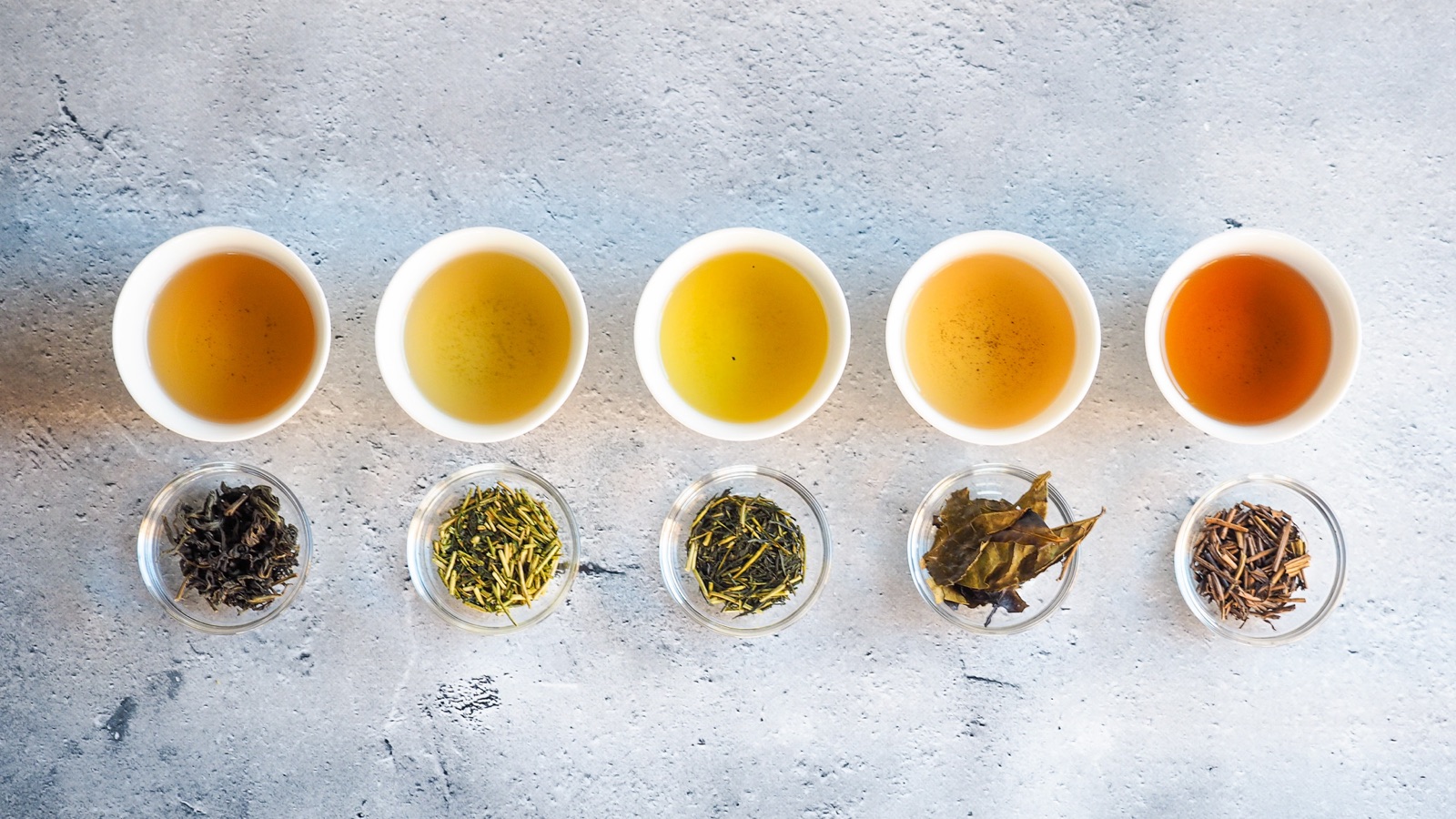
Five Hojicha. A New Tradition from Nagoya.
At mirume, CHA-NOVATIVE means carrying tradition forward through new ideas.
These five styles of hojicha challenge the assumption that all hojicha tastes the same.
Why five hojicha?
When you hear "hojicha," you probably picture one thing: a brown cup with a toasty aroma. I wanted to break that picture. I wanted people to taste these and think, even hojicha can be this different?
We set ourselves two rules. No flavoring. Nothing added but the tea itself.
We are tea makers, and we have no interest in adding the scent of flowers or fruit to make a tea seem like something it isn't. How far can you go with just tea leaves and fire? We decided to find out across five teas. Why five? Because five felt right, like the five-member hero squads of Japanese sentai shows (think Power Rangers). That's the only reason.
The first one we made was the Sand-Roasted Stem Hojicha.
What is the heart of hojicha? I decided it was aroma. So we chose stems, which stay out of the aroma's way, and roasted them in hot sand. The heat reaches all the way to the core, and a sweet aroma rises. My father and I made it together, and it became the standard for everything that followed.
If sand-roasting is a dark roast, there should be a light roast too. The White Stem Hojicha takes the stems and leaves of gyokuro and kabusecha and roasts them lightly, each on its own.
In Kyoto there is a tea called kyobancha, made by roasting the leaves by hand. The name says "bancha," but because the leaves are roasted, it is technically a hojicha. It is made so differently from the hojicha most people imagine that it is almost an outlier, and very few people still roast it by hand. We put one tea made this way among the five.
If hojicha is roasted green tea, what happens when you roast something that isn't green tea? We tried black tea, and it failed. It either stayed black tea or turned into ordinary hojicha, and the best of each disappeared. Oolong was different. Roasting made the oolong's aroma stronger, not weaker. Instead of adding up, the two multiplied. That became the Oolong Hojicha.
Finally, what happens if you make hojicha from the finest leaves there are? Only the bud and the two leaves beneath it, picked at just 3 cm. Picking that early means the same field yields only about half of what the finest gyokuro does. Roasted slowly at a low temperature, these shoots become the First-Pick Hojicha. They have so little fiber that even after roasting, the leaves are soft enough to eat.
Nagoya is a hojicha city, too. Myokoen's roasted tea is certified as an official Nagoya souvenir, and I have heard that some old coffee shops here used to bring a cup of hojicha, on the house, to customers who had finished their coffee.
In this city, and as far as I know anywhere in Japan, no tea shop makes five kinds of hojicha without adding any flavoring. But it's more fun this way. I want to make tea more interesting. Lower the threshold, and get more people drinking tea. In the end, that's all I want to do.
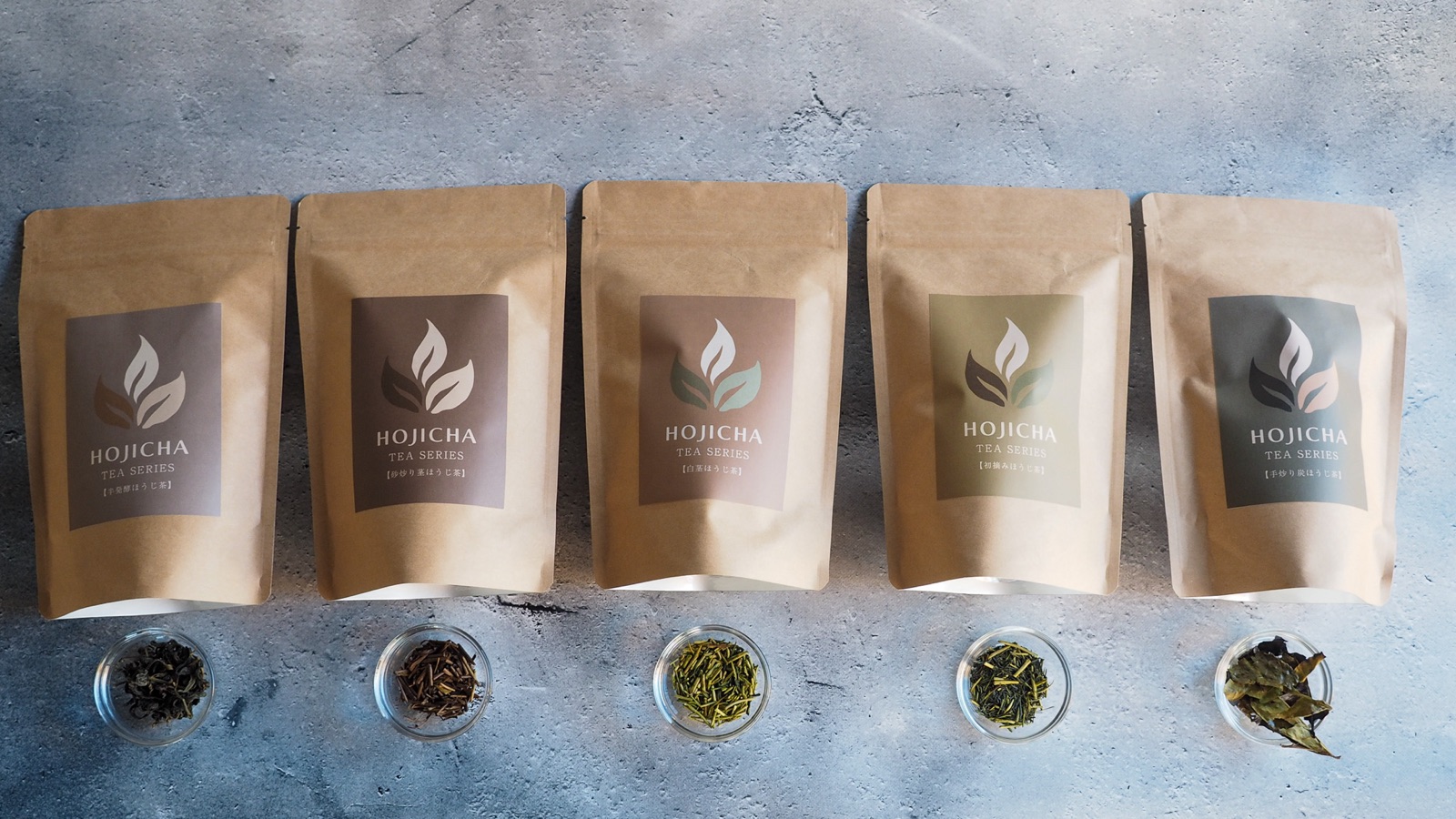
The five at a glance
| No. | Name | Made from | How it's roasted | In a word |
|---|---|---|---|---|
| 1 | Sand-Roasted Stem Hojicha | Stems from the first spring harvest only | Roasted together with hot sand | Rich roasted aroma and natural sweetness from the stems. |
| 2 | White Stem Hojicha | Stems and leaves of gyokuro and kabusecha | Stems and leaves roasted lightly and separately, then combined | Gentle, clean, and naturally sweet. |
| 3 | Smoky Hand-Roasted Hojicha | Hard bancha leaves and twigs | Roasted by hand over a charcoal fire | Bold, smoky, and clean. |
| 4 | Oolong Hojicha | Partially oxidized oolong leaves | Roasted gently | Floral aroma with a gentle roasted character. |
| 5 | First-Pick Hojicha | Spring shoots picked at 3 cm | Slowly, at a low temperature | Picked at only 3 cm. About half the yield of the finest gyokuro. |
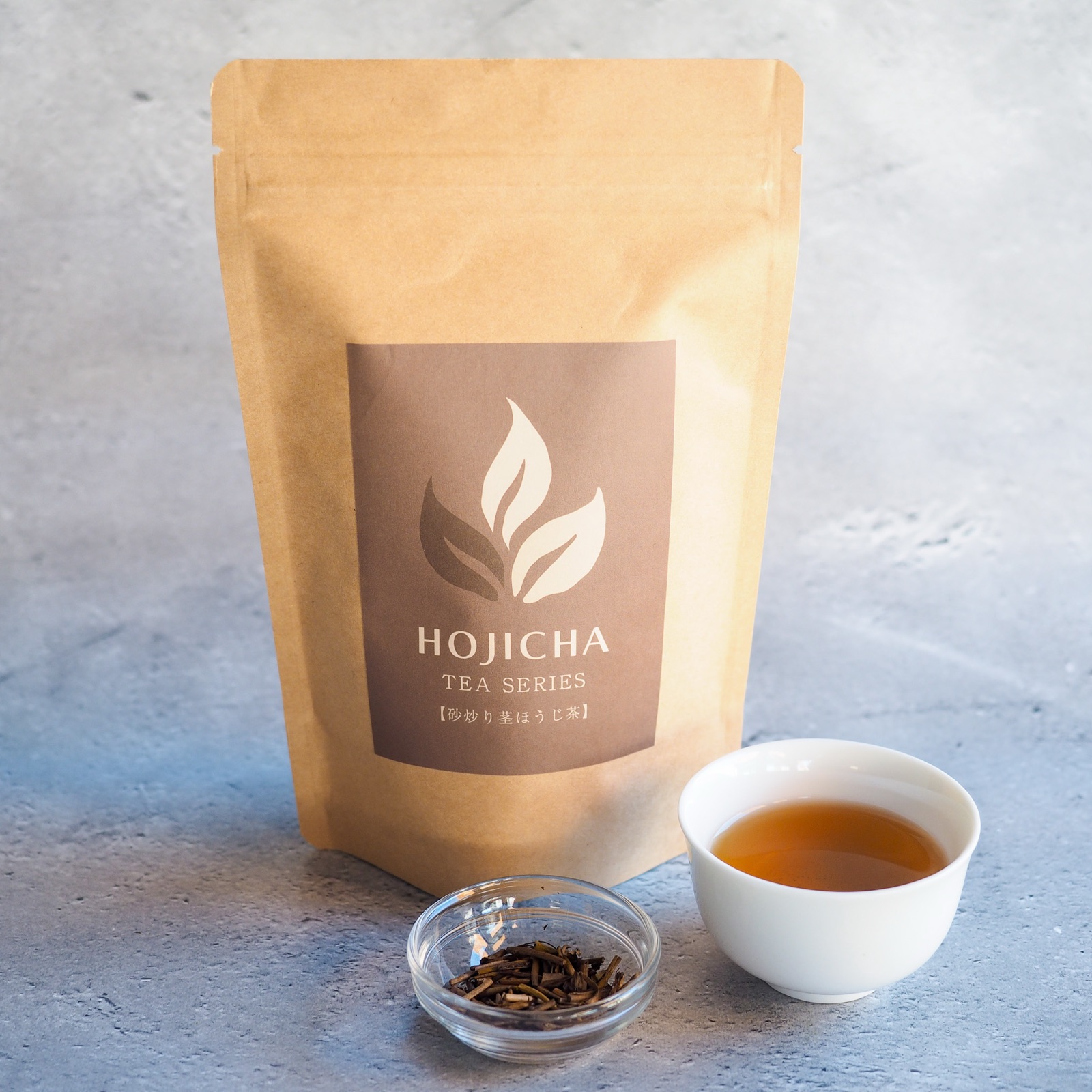
No.1
砂炒り茎ほうじ茶
Sand-Roasted Stem Hojicha
Rich roasted aroma and natural sweetness from the stems.
Made only from stems of the first spring harvest.
Heated sand surrounds the stems, so heat reaches them evenly from every side, by contact and by radiant heat.
The result is a deep roasted aroma, the natural sweetness of the stems, and a bright amber liquor.
We did not make this tea because we thought it would sell. It began with a maker's obsession: to make a truly good hojicha.
Not just any stem will do. Thick stems give off little sweet aroma, and thin ones scorch. In our fields in Matsusaka, the best stems come in late May, just before the first harvest winds down. When we roasted stems from that window, the sweet aroma came through most clearly.
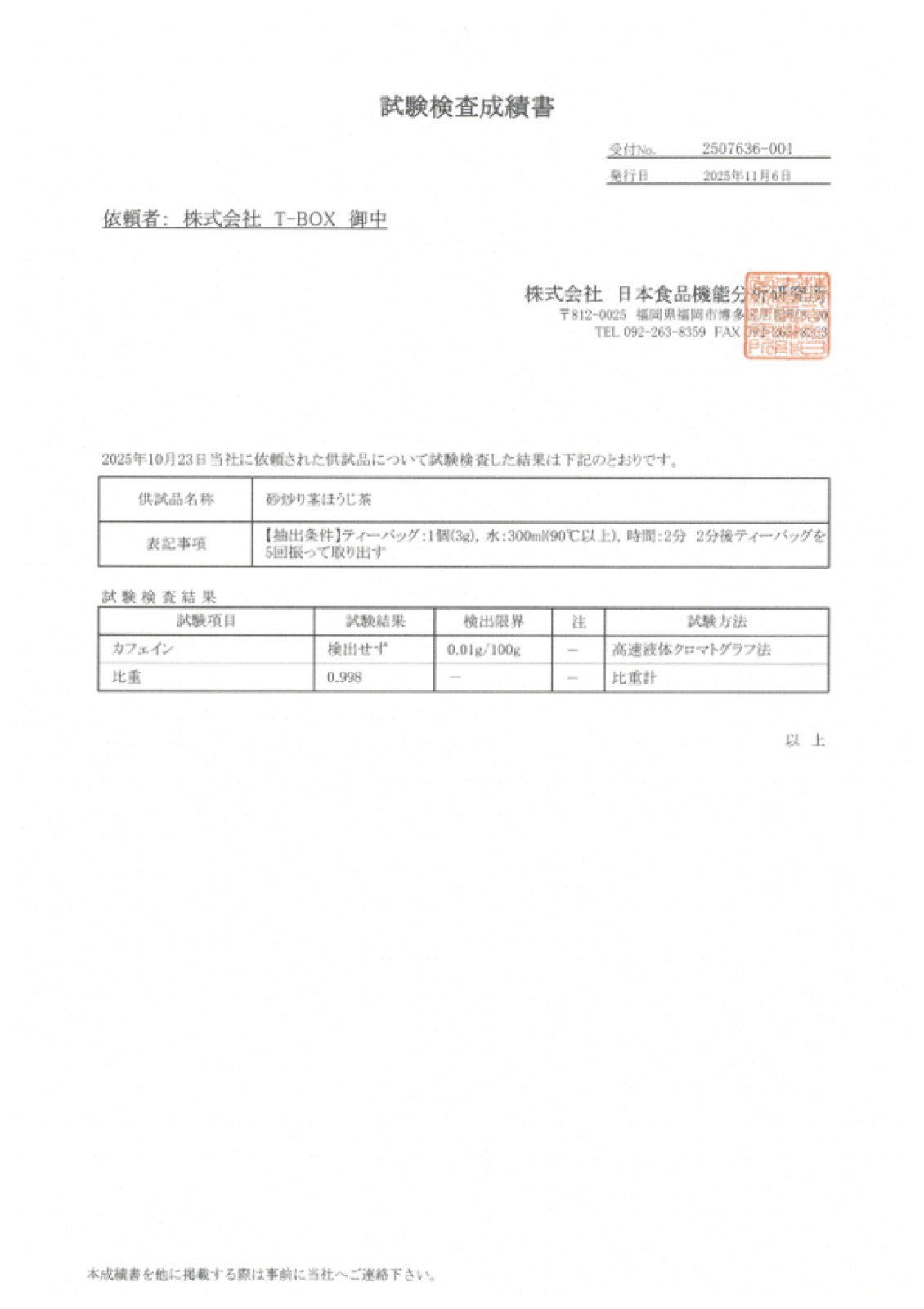
Stems naturally contain less caffeine than leaves. As more customers asked about caffeine, I used to tell them it "should be lower than ordinary hojicha." "Should be" didn't feel like enough, so we had it tested. The result was not detected.
Caffeine-free came later, almost by accident, on the way to flavor.
How to brew
Tea bag / 1 bag / 250–300 ml / just-boiled water / 2 min
Loose leaf / 4 g / 300 ml / just-boiled water (90–100°C) / 2 min
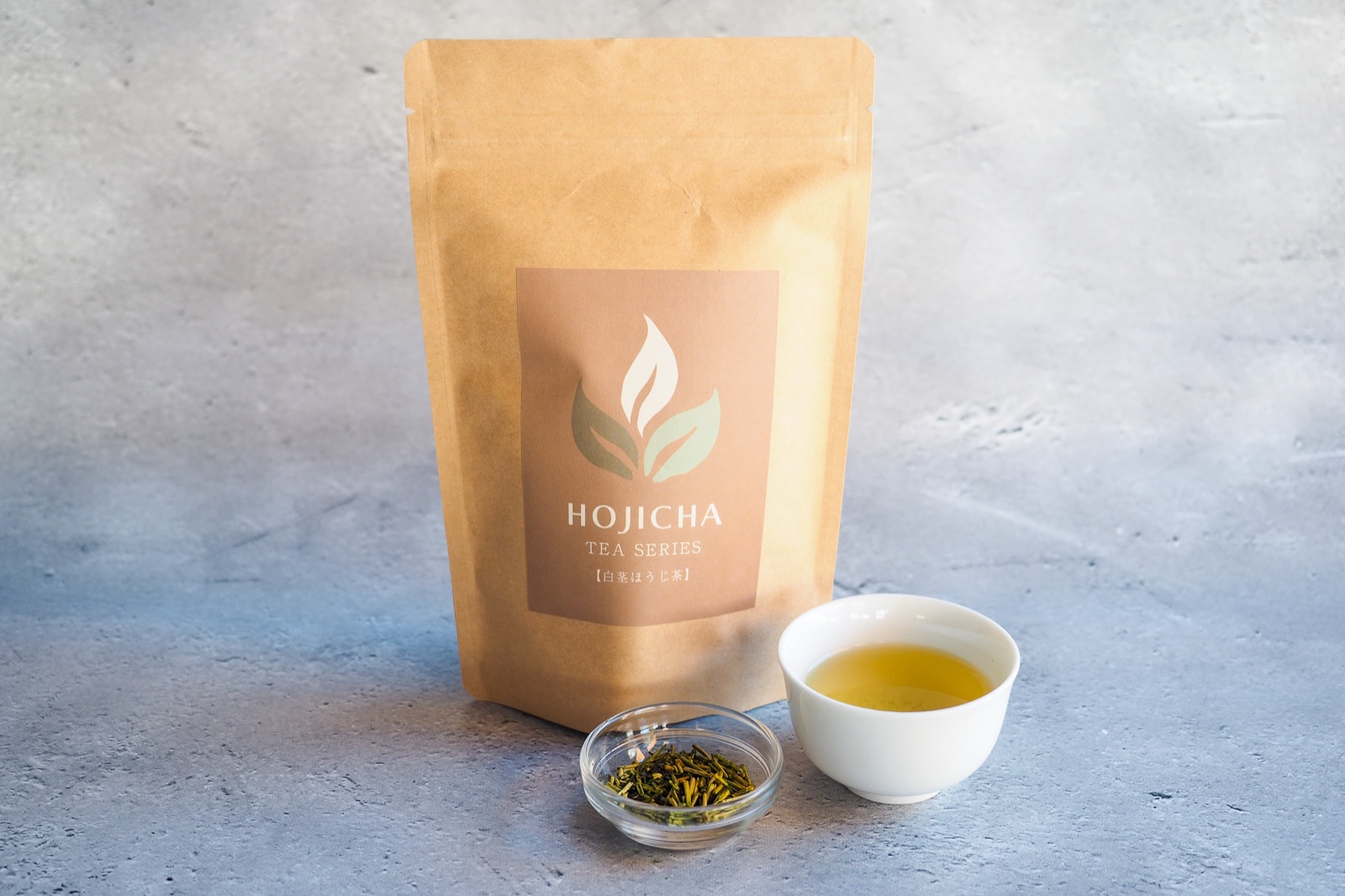
No.2
白茎ほうじ茶
White Stem Hojicha
Gentle, clean, and naturally sweet.
Made from the stems and leaves of shaded teas such as gyokuro and kabusecha.
Stems and leaves respond to heat differently, so we roast them separately.
The stems are roasted until they puff and turn pale, almost white. The leaves get a lighter roast of their own.
Blended after roasting: fresh green notes, a light roasted aroma, and natural sweetness.
We were aiming for a light roast. We wanted a hojicha that kept the character of green tea.
At first we roasted stems and leaves together, and it didn't work. Set the heat for the stems, and the leaves overcooked and turned brown. Set it for the leaves, and the stems didn't get enough. So we roasted stems on their own and leaves on their own, brought each to its best, and then combined them. The stems go until the green turns almost white. But what's best for each on its own isn't always best once they're blended, and a little fine-tuning got us to where it is now.
One principle holds it together: a hojicha that never loses the character of green tea.
How to brew
Tea bag / 1 bag / 250–300 ml / just-boiled water / 30 sec
Loose leaf / 5 g / 300 ml / just-boiled water / 60 sec
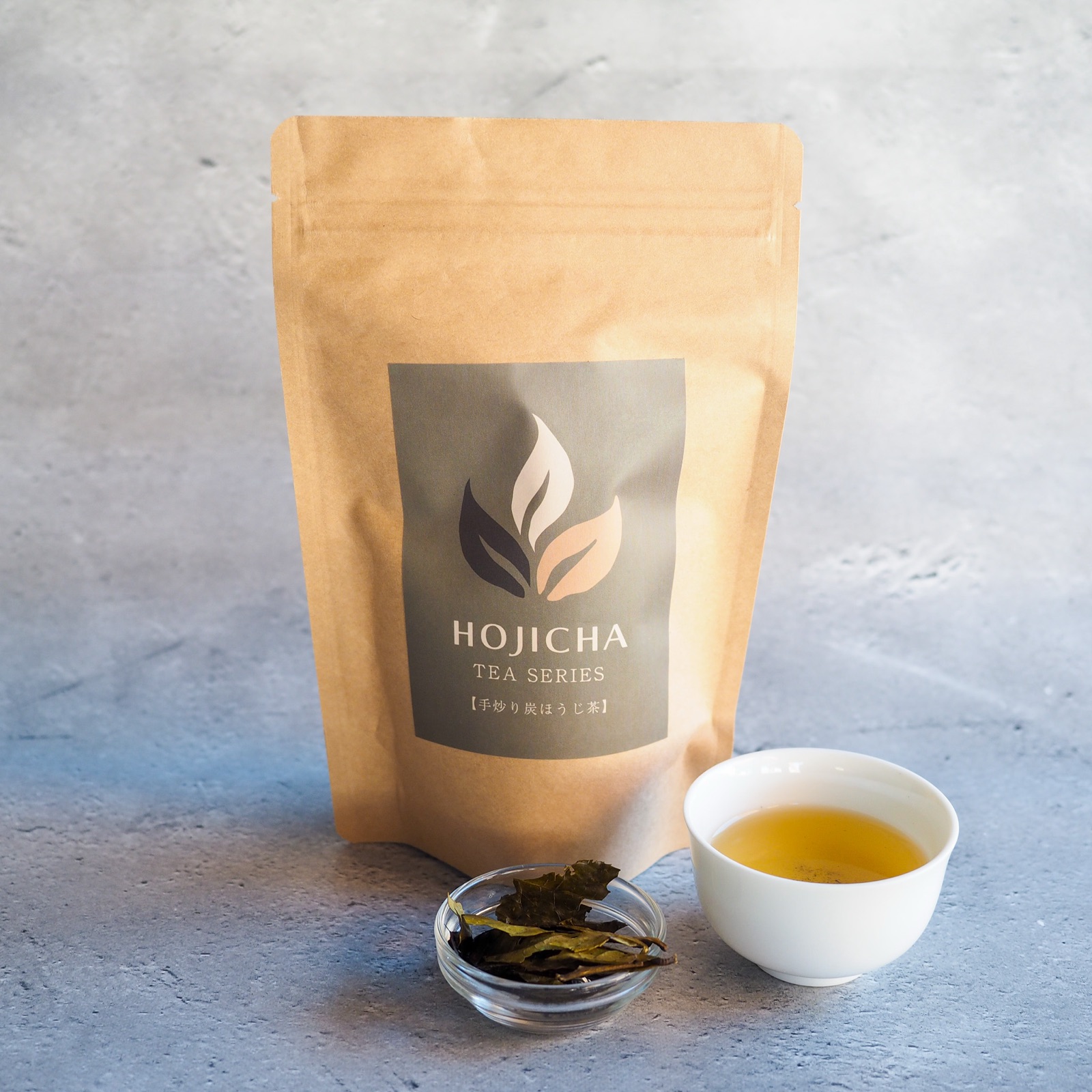
No.3
手炒り炭焙じ茶
Smoky Hand-Roasted Hojicha
Bold, smoky, and clean.
Made from the hard leaves of bancha, twigs and all.
Roasted by hand on hot iron over a charcoal fire, one small batch at a time.
This is the old Kyoto bancha method, and few people still roast it by hand.
The fire leaves an aroma of charcoal and smoke, yet the finish stays clean and light.
The "charcoal" in its Japanese name refers to the fire, not to any added flavor.
This is the most primitive tea of the five.
Where I'm from, there are a lot of mountains, and once or twice a year the community gets together to clean them up. On the winter cleanups, we pick the tea that grows wild in the hills, toast it over the bonfire, roll it lightly by hand, and simmer it in a kettle. It's an old way of drinking tea called yakicha, "grilled tea," and it may be the oldest way people have drunk tea at all.
This tea, too, is grilled whole, hard leaves and twigs together, over a charcoal fire. That's why it smells of charcoal and smoke. The "charcoal" in its Japanese name refers to that fire.
Of the five, it is the roughest and the oldest. It sits at the opposite end from the First-Pick, where the youngest shoots are roasted slowly at low heat.
How to brew
Tea bag / 1 bag / 250–300 ml / just-boiled water / 2 min
Loose leaf / 4 g / 300 ml / just-boiled water / 2 min
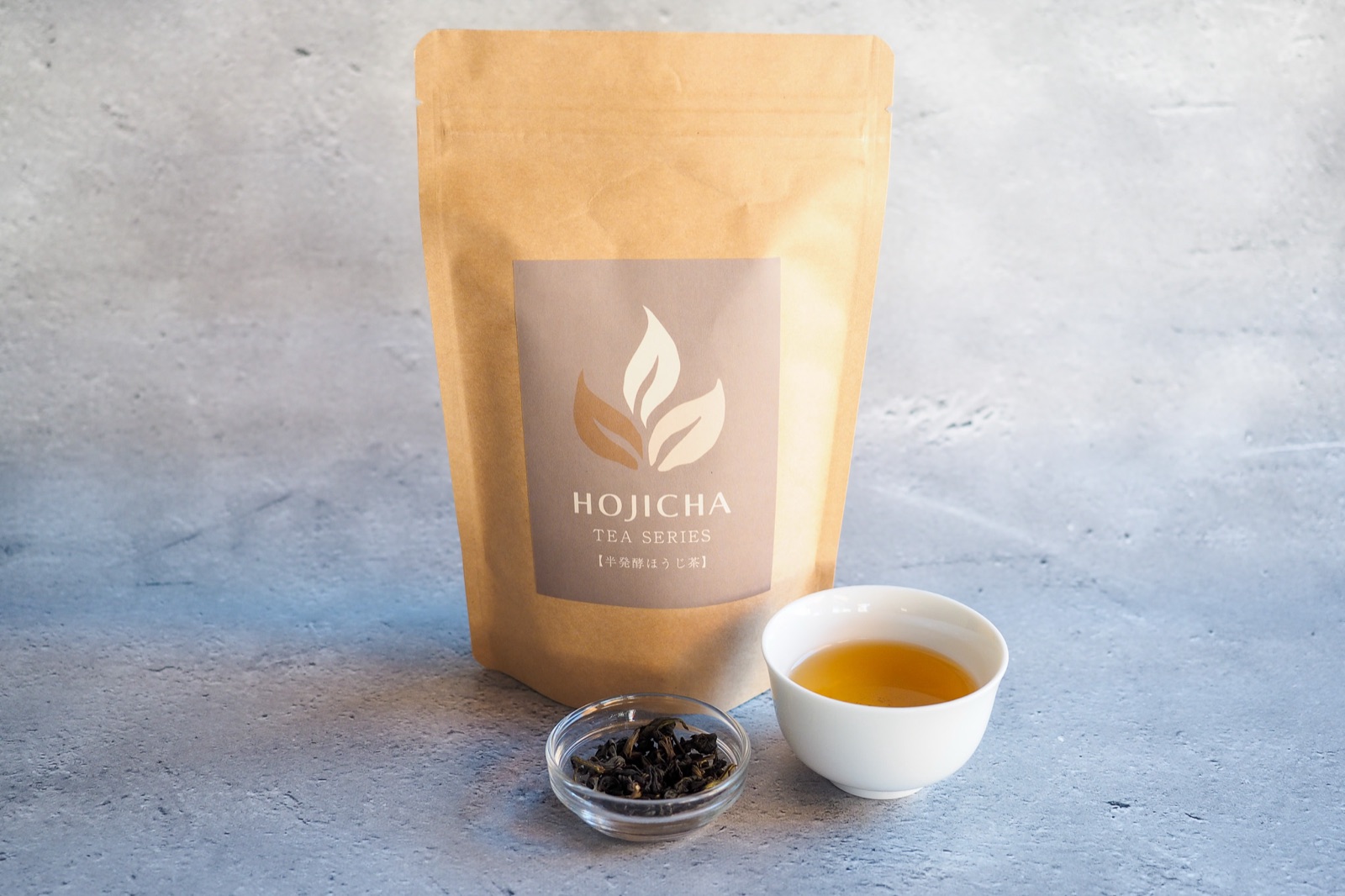
No.4
半発酵ほうじ茶
Oolong Hojicha
Floral aroma with a gentle roasted character.
The leaves are partially oxidized before roasting, using the same basic steps as oolong tea: withering, tossing, and heat-fixing.
The oxidation is what creates the naturally floral aroma. No flavoring is added.
The roast is kept gentle, so the warmth sits behind the flowers rather than over them.
Roast oolong, and the floral aroma gets stronger. We expected it to fade, so this surprised us. The roast doesn't sit on top. It pushes the original aroma forward.
With green tea, most of the flavor comes from the maker's choices, such as how to shade the plants, how to steam, and how to roast. That's why we don't choose green tea by cultivar. Partially oxidized tea is the opposite. Withering, the step where picked leaves are left to wilt naturally, shapes the flavor, so the character of the cultivar comes straight through.
The oolong we use comes from a farming family that has been developing its own tea cultivars for two generations. This cultivar exists only on their farm.
How to brew
Tea bag / 1 bag / 250–300 ml / just-boiled water / 1 min
Loose leaf / 4 g / 300 ml / just-boiled water / 1 min
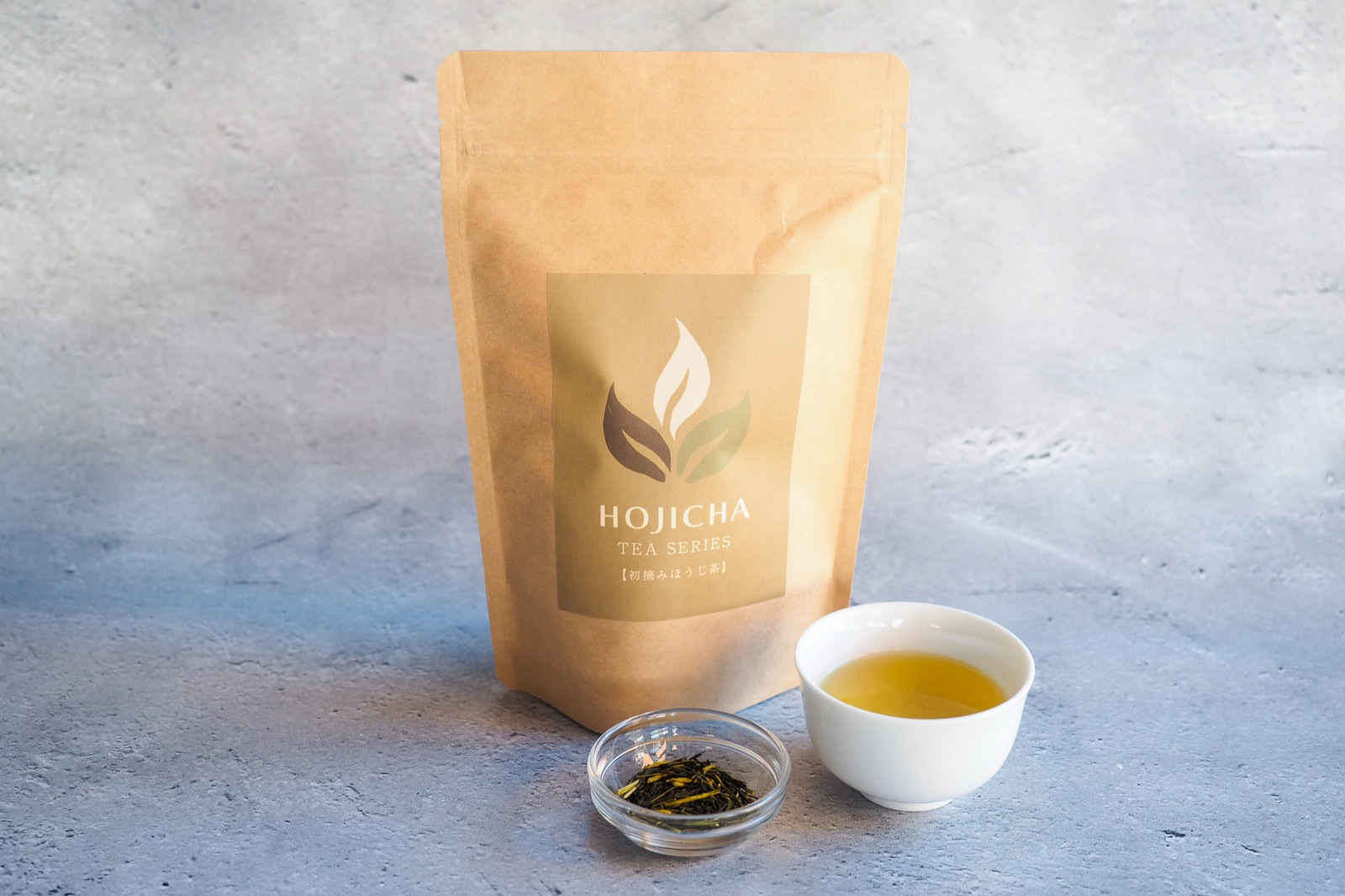
No.5
初摘みほうじ茶
First-Pick Hojicha
Picked at only 3 cm. About half the yield of the finest gyokuro.
These spring shoots are harvested when they are only about 3 cm long. Even the finest gyokuro is picked at around 6 cm, so this tea gives about half as much from the same field.
The shoots are so low in fiber that even after processing, the finished leaves are tender enough to eat.
They are roasted slowly at a low temperature to keep their delicate character and umami.
No one makes hojicha from the finest tea leaves. In the green tea world, the rule is that the better the leaf, the less you do to it, with short steaming, light rolling, and a light final firing. Nobody given the finest beef would braise it in red wine, and in the same way, some tea farmers and merchants would call this sacrilege. So there was no know-how, and anyone who tried would be laughed at.
My father, though, had long wanted to make a hojicha you could steep again and again in a teapot, the way you do with green tea.
One year, some of our finest leaves, picked at 3 cm, didn't turn out the way we had hoped and sat in the fridge. My father used them to experiment, and through trial and error he found a way to roast them right up to the edge of scorching, and stop there. Today we pick new shoots specifically for this tea.
The roast is almost too light to call it hojicha. Any further and the leaves would burn. That lightness is itself proof of how fine the leaf is. The tea was finished when both the roasted aroma and the long finish of the leaf were there together.
How to brew
Tea bag / 1 bag / 250–300 ml / just-boiled water / 30 sec
Loose leaf / 5 g / 80 ml / 60°C / 60 sec (first infusion; raise the water temperature for each infusion after that, up to 3 or 4)
About caffeine
No caffeine was detected in brewed Sand-Roasted Stem Hojicha (<0.01 g per 100 g). No decaffeination process is used.
The test was run on tea brewed from one 3 g tea bag in 300 ml of water at 90°C or above for 2 minutes, with a detection limit of 0.01 g per 100 g of brewed tea (about 100 ml). Under these conditions, no caffeine was found.
Testing laboratory: 株式会社日本食品機能分析研究所 (Nihon Shokuhin Kino Bunseki Kenkyusho Co., Ltd.), a food analysis laboratory in Fukuoka, Japan. Report issued November 6, 2025.
The other four teas have not been tested.
How to buy
All five are available at our shop in Nagoya, as tea bags or loose leaf. Loose leaf is packed to order, and each bag gets a sticker with its number. If you get home and can't remember which one it was, match the number on the bag to the number on this page.
We do not ship overseas.
Visit
mirume1-36-57 Nagono, Nishi-ku, Nagoya, Aichi 451-0042
1F shop, 2F cafe
Open every day, except a few days over the New Year holidays.
Weekdays: 11:00 to 19:00
Weekends and holidays: 9:00 to 19:00
No reservation needed. Just walk in.
Credit cards, Apple Pay, transit IC cards such as Suica, and QR payments including PayPay, Alipay and WeChat Pay are all accepted. Cash too, of course.
A 7-minute walk from Kokusai Center Station or Marunouchi Station. A large paid parking lot is right in front of the shop.